

Testing a game often means playing the same scenario hundreds of times.
Quality Assurance (QA) teams run missions repeatedly, experiment with unusual situations, and verify that every mechanic behaves the way designers expect. It’s meticulous work that helps keep games stable long before players ever experience them.
But as modern games grow larger and more complex, covering every possible interaction becomes increasingly difficult.
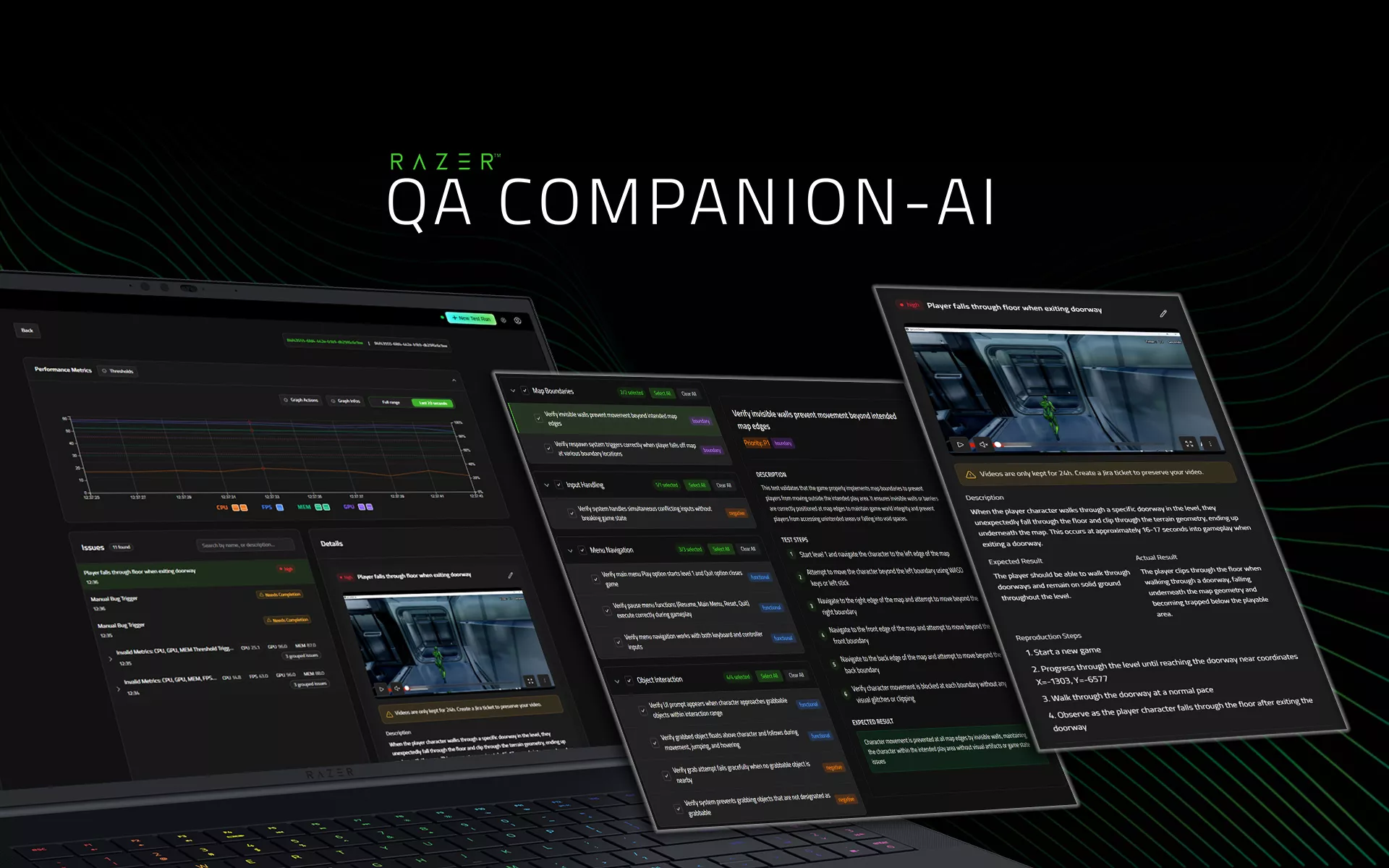
At GDC 2026, Razer is introducing the next evolution of Razer QA Companion-AI, expanding automated QA with vision-based bug detection and AI-generated test planning.
Alongside these updates is an early preview of something new: AI gameplay agents capable of executing gameplay tests autonomously.
Instead of simply observing gameplay, these agents can run test scenarios, validate results, and report issues automatically. These capabilities build on a system Razer first introduced a year earlier.
From Razer QA Copilot to Razer QA Companion-AI
When Razer introduced the Razer AI QA Copilot at GDC 2025, the goal was straightforward: reduce the time testers spend documenting issues so they can focus on understanding them.
The system analyzes game events in real time and flags situations that may not behave as designers intended. From there, the AI generates structured bug reports with video evidence attached. Instead of writing reports from scratch, testers can review findings, confirm issues, and move directly toward resolving them.
With the latest updates, Razer QA Companion-AI builds on that foundation.
The platform now supports broader automation across QA tasks, helping teams expand test coverage while reducing repetitive work.
Key enhancements include:
- Zero-integration deployment — works without requiring code changes or additional integrations
- Vision-based bug detection — identifies rendering, physics, animation, and collision issues from gameplay footage
- AI-generated test planning — creates structured gameplay checks from prompts or game design documents
These updates make it easier for studios to introduce automated testing into existing development processes and QA workflows without disrupting how teams already work. One of the most visible changes is how the system analyzes gameplay itself.
Vision-Based QA That Watches Gameplay
Razer QA Companion-AI can analyze recorded gameplay footage directly.
By examining what appears on screen, the system can detect visual issues players might notice immediately—animation glitches, physics problems, or unexpected rendering behavior.
When a potential issue is detected, the system generates a complete bug report that includes:
- The identified issue
- Suggested steps to reproduce it
- Attached gameplay footage showing the problem
This approach reflects how players experience games: by watching what happens on screen.
It also helps teams identify issues that might otherwise take much longer to capture or explain.
Turning Design Ideas Into Tests
Before a game launches, QA teams check more than just the intended path through the game.
They also explore unusual situations players might trigger – unexpected inputs, strange interactions between systems, or gameplay moments that behave differently than intended.
Planning these checks can take time.
With Razer QA Companion-AI, testers can generate structured gameplay tests from simple prompts or optional game design documents (GDDs). Instead of building every test from scratch, teams can start with generating a set of test cases and refine them as needed.
This allows testers to spend less time writing documentation and more time verifying how the game actually behaves.
AI Gameplay Agents: When AI Starts Playing the Game
Automation already helps QA teams analyze issues and generate tests. The next step is allowing systems to execute those tests on their own.
With AI gameplay agents, testing systems can begin to play the game themselves.
These agents are designed to:
- Select a gameplay test
- Play through the sequence autonomously
- Compare expected results with actual outcomes
- Return a clear pass or fail summary
Rather than simply analyzing gameplay data, these systems can run gameplay tests themselves.
As games continue to evolve through updates and live-service content, this kind of autonomous testing could help developers verify systems at a scale that manual testing alone would struggle to cover.
Behind the Scenes, Better Games for Everyone
Tools like Razer QA Companion-AI may work behind the scenes, but their impact reaches every player. Better testing leads to smoother launches, fewer unexpected bugs, and games that evolve more reliably over time.
At GDC 2026, Razer is showcasing how vision-based QA, automated test planning, and AI gameplay agents can help developers test games at a scale that matches modern game design.
Learn more about Razer QA Companion-AI.
